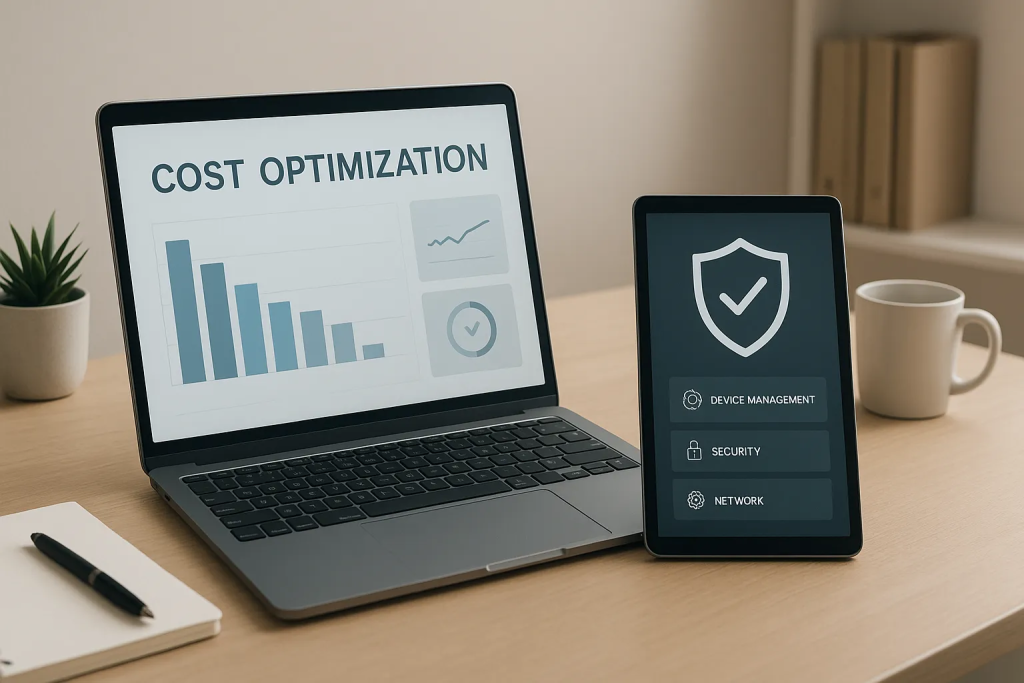
Many organizations try to reduce IT expenses, but cutting the wrong areas can increase security risks and operational instability. The goal is not just to spend less — it’s to spend smarter. Modern businesses can reduce costs significantly while maintaining, and often improving, their security posture by consolidating tools, strengthening device visibility, and relying on proactive IT strategies. This guide explains how to optimize IT budgets without exposing your organization to unnecessary risk.
Why Most Businesses Overspend on IT
Organizations often underestimate how much IT inefficiencies add up. Small issues — duplicate tools, unmanaged devices, outdated processes — can quietly drain budgets over months and years.
Legacy tools
Older systems require expensive maintenance, slow updates, and specialized expertise. Their inefficiency forces companies to rely on additional tools and workflows that modern systems eliminate.
Overlapping software subscriptions
Many organizations pay for multiple platforms that perform the same function. Without regular audits, duplicate licenses and redundant SaaS tools accumulate, inflating annual costs.
Unmonitored user devices
Unmanaged laptops, tablets, and mobile phones lead to inconsistent software versions, higher support needs, unnecessary downtime, and increased security exposure. Each unmanaged device adds risk and cost.
Identifying these overspending patterns is the first step toward meaningful cost control.
Consolidating Tools for Greater Efficiency
Consolidation is one of the fastest ways to reduce IT spending without losing capability. Integrated platforms streamline workflows and minimize complexity.
Unified dashboards
Centralized dashboards let IT teams manage systems more efficiently. Instead of switching between scattered tools, they gain visibility from a single interface, reducing support time and human error.
Automated deployment
Automation cuts manual configuration work. Standardized deployment saves time on software updates, device provisioning, and patching — reducing both labor and downtime.
Centralized device visibility
Centralized monitoring helps IT teams track device status, software versions, compliance levels, and potential threats. This improves both security and operational efficiency.
Consolidation creates consistency across the environment, which translates into long-term cost savings.
Mobile Device Management: A Direct Path to Lower IT Costs
Businesses often overlook how much money is lost due to unmanaged devices, breaches, and inconsistent updates. A strong mobile device management solution can eliminate many hidden costs.
How MDM reduces device loss and theft
Lost or stolen devices can be remotely locked or wiped, preventing costly breaches and avoiding emergency incident responses. Tracking features also improve recovery rates and reduce replacement costs.
Standardizing updates and apps
MDM lets IT teams enforce consistent operating system updates, approved apps, and security configurations. This reduces support needs and improves stability across all devices.
Lowering support overhead
When devices follow uniform policies, troubleshooting becomes faster and easier. IT teams spend less time on routine fixes and more time on strategic initiatives.
MDM quickly pays for itself with improved efficiency, predictable operations, and fewer security incidents.
Preventing Costly Downtime With Proactive IT
Downtime is one of the most expensive IT failures a business can experience. Even brief outages can lead to lost revenue, reduced productivity, and significant recovery costs.
Monitoring and early detection
Continuous monitoring helps detect anomalies such as performance issues, suspicious logins, or system errors before they escalate.
Predictive maintenance
Using analytics, IT teams can predict hardware failures, capacity issues, and performance degradation. Fixing these during scheduled maintenance prevents emergency outages.
Proactive support reduces downtime and eliminates expensive last-minute repairs.
Leveraging 24/7 IT Support to Control Costs
Reactive support often leads to high emergency costs and unpredictable repair timelines. Continuous system monitoring and accessible help desk services offer measurable financial benefits.
Avoiding overnight outages
Systems run 24/7. If a server fails or a breach occurs at night, the impact can be severe. Always-available support detects and resolves issues before they affect operations.
Reducing overtime
Without round-the-clock support, internal staff must handle after-hours emergencies, causing overtime and burnout. Continuous support eliminates unnecessary labor costs.
Eliminating break/fix emergencies
Emergency fixes cost far more than proactive maintenance. Continuous monitoring prevents issues before they become expensive crises.
24/7 IT services stabilize budgets and ensure smoother operations year-round.
ROI Framework for IT Cost Reduction
To make informed decisions, organizations must evaluate savings using measurable ROI. A structured framework helps determine where investments deliver the greatest impact.
CapEx vs OpEx comparison
Shifting from capital expenditures to operational expenses — such as managed services or cloud solutions — reduces upfront spending and creates predictable monthly costs.
Staff time saved
Automation, standardized devices, and consolidated tools reduce manual IT workload. Time saved can be redirected to strategic projects that support long-term growth.
Device lifecycle optimization
Better visibility into device health and usage helps organizations extend hardware lifespan, avoid unnecessary replacements, and prevent overbuying.
This framework ensures leaders can achieve meaningful cost reductions while maintaining strong security.
Conclusion: Smart Spending for Modern IT Teams
Reducing IT costs does not require cutting security. By eliminating redundant tools, adopting MDM, using proactive monitoring, and relying on 24 / 7 IT support, businesses can reduce costs while strengthening their infrastructure.
Organizations that invest strategically, not minimally, position themselves to stay secure, scalable, and competitive in an evolving digital landscape.